Groenplein Borrelmanneke
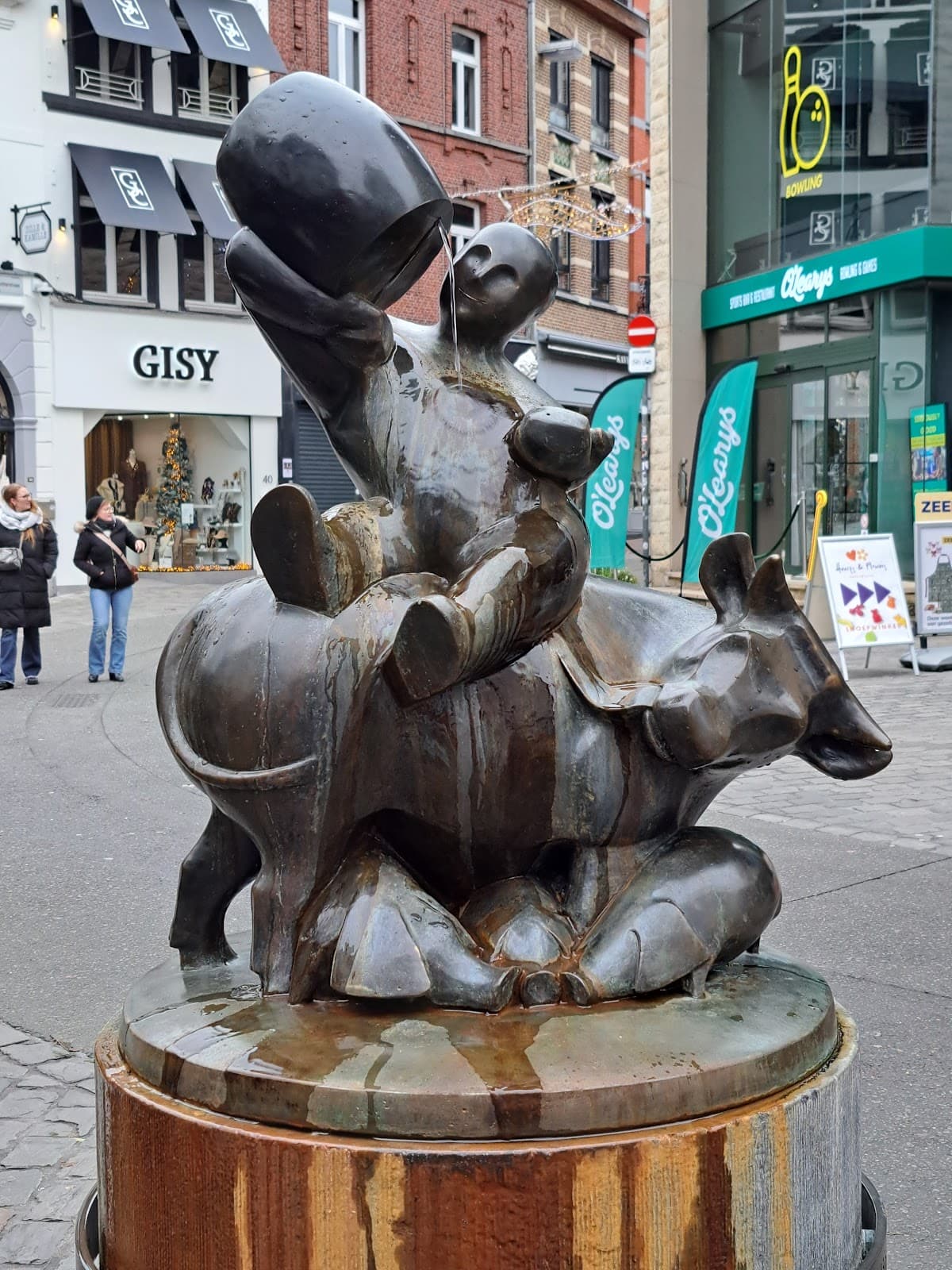
A charming statue symbolizing Hasselt's jenever history and its agricultural roots, featuring a man, an ox, and pigs.
Highlights
Must-see attractions

Social
From TikTok & Reddit
Best Time
Best light for photos
Groenplein Borrelmanneke
Best Time
Best light for photos
Highlights
Must-see attractions
A charming statue symbolizing Hasselt's jenever history and its agricultural roots, featuring a man, an ox, and pigs.
"The Borrelmanneke is a cool idea, something interesting, personifying Hasselt's jenever history."

📸 Find Both Statues
Seek out both the Borrelmanneke and Borrelvrouwke for the full story! :camerawithflash:
📜 Learn the History
Understand the jenever cycle to truly appreciate the statues' meaning. :scroll:

Highlights
Discover the most iconic attractions and experiences
The Borrelmanneke Statue
Corner of Maastrichterstraat and Sint-Jozefstraat
A charming statue personifying Hasselt's jenever history, pouring gin astride an ox with pigs below.
The Borrelvrouwke Statue
Near Visit Hasselt
The female counterpart to the Borrelmanneke, a nod to Juniper, completing the jenever symbolism.

Jenever History Connection
Hasselt
Learn about the historical cycle of jenever production, livestock farming, and agriculture in Hasselt.
Plans like a pro.
Thinks like you
Planning Your Visit
Understand the Symbolism
Locate the Pair
Best Times
Insider Tips
from TikTok, Instagram & Reddit
📸 Find Both Statues
Seek out both the Borrelmanneke and Borrelvrouwke for the full story! :camerawithflash:
📜 Learn the History
Understand the jenever cycle to truly appreciate the statues' meaning. :scroll:
📍 Easy to Find
Located conveniently on street corners, perfect for a quick stop. :round_pushpin:
Tips
from all over the internet
📸 Find Both Statues
Seek out both the Borrelmanneke and Borrelvrouwke for the full story! :camerawithflash:
📜 Learn the History
Understand the jenever cycle to truly appreciate the statues' meaning. :scroll:
📍 Easy to Find
Located conveniently on street corners, perfect for a quick stop. :round_pushpin:
What Travellers Say
Reviews Summary
Visitors find the Borrelmanneke a charming and historically significant statue, appreciating its connection to Hasselt's jenever production. The accompanying Borrelvrouwke adds to the narrative. While small, the statues offer a unique glimpse into local heritage.
"Fun little statue,referring to the history of making 'Jenever' in Hasselt, a local liquor."
Cedric Bru
"I love you, Amelka 💚💜💙❤️
The fountain was designed by sculptor Laurent Boonman in 1981. And it's a cool idea, something interesting."
karol galuba
"The cycle of Hasselt jenever is personified in the "borrelmanneke" (little drinker).
You can find the statue on the corner of Maastrichterstraat and Sint-Jozefstraat.
In the heyday of jenever production, the distillery owners were primarily (large) landowners, cattle farmers, and bankers.
One explanation for this was the striking, natural cycle that existed between the distilleries, livestock farming, and agriculture.
With the animal manure, poor heathland and sandy soils were fertilized, so that barley and rye could be grown there, the basic ingredients of jenever, which in turn produced grain.
Thus, the cycle was closed.
In Hasselt, the beautiful statue fountain, the "Borrelmanneke," symbolizes this cycle. He depicts a "little man" pouring gin from a barrel and sitting astride an ox. And between the ox's legs, pigs are feasting on trot.
Fifty meters away stands the
"Borrelvrouwke" (little woman)."
Peter Van Renterghem
What People Like
What People Dislike
Frequently Asked Questions
🚇 🗺️ Getting There
The Borrelmanneke is located at the intersection of Maastrichterstraat and Sint-Jozefstraat in Hasselt, making it easily accessible on foot within the city center. If arriving by car, look for nearby parking facilities. Public transport options are also available to reach the city center.
Yes, there are several parking garages and street parking options available in the vicinity of the Groenplein Borrelmanneke. It's advisable to check local parking apps or signs for availability and pricing.
Hasselt's city center is well-served by public transport. Buses will drop you off within walking distance of both the Borrelmanneke and Borrelvrouwke statues.
🎫 🎫 Tickets & Entry
No, the Borrelmanneke and Borrelvrouwke are public art installations and can be viewed freely at any time. There are no admission fees.
The statues are outdoors and accessible 24/7. You can visit them whenever you like.
📸 📸 Photography
Daytime offers the best natural light for clear photos of the Borrelmanneke and its intricate details. Golden hour can also provide beautiful, warm lighting.
The statues are located on street corners, so you can capture them from various angles. Experiment with different perspectives to get unique shots.
🎫 📜 History & Culture
The Borrelmanneke symbolizes Hasselt's historical jenever (gin) production and its close ties to agriculture and livestock farming, illustrating a closed cycle of production.
In its heyday, Hasselt's jenever production was intrinsically linked to agriculture. Animal manure fertilized the land for growing barley and rye (jenever ingredients), creating a self-sustaining cycle that the statues commemorate.
The fountain was designed by sculptor Laurent Boonman in 1981.
Visit Hasselt is a good starting point for local history. The statues themselves serve as a visual representation of this heritage.
For Different Travelers
Tailored advice for your travel style
👨👩👧 Families with Kids
🚶♀️ History Buffs & Culture Enthusiasts
Deep Dives
In-depth insights and expert knowledge
The Symbolism of the Borrelmanneke
This cycle involved a symbiotic relationship between distilleries, livestock farming, and agriculture. The manure from livestock was used to fertilize the poor heathland and sandy soils, enabling the cultivation of barley and rye – the essential grains for jenever. The grain, in turn, supported the livestock. The Borrelmanneke visually encapsulates this closed-loop system, highlighting how the city's prosperity was once tied to this interconnected agricultural and distilling industry.
Its counterpart, the Borrelvrouwke, located near Visit Hasselt, further emphasizes this connection, serving as a nod to Juniper, a key botanical in gin. Together, these statues offer a unique and artistic insight into the cultural and economic heritage of Hasselt.
Discovering the Borrelmanneke and Borrelvrouwke
Just a short distance away, approximately fifty meters, you'll find the Borrelvrouwke. This complementary statue is located near Visit Hasselt, the city's tourist information center. Finding both statues provides a more complete understanding of the historical narrative they represent.
These statues are not just artistic pieces but also historical markers. They serve as a charming and accessible way for visitors to connect with Hasselt's unique heritage, particularly its significant role in the jenever industry. Their presence adds character to the urban landscape and offers a glimpse into the traditions that shaped the region.

Social
from TikTok, Instagram & Reddit