Tobinodai Shell Midden Park
Explore Japan's early Jomon past at Tobinodai Shell Midden Park, home to the first 'roana' hearths and a rare communal burial site.
Highlights
Must-see attractions

Social
From TikTok & Reddit
Best Time
Pleasant weather for exploring
Tobinodai Shell Midden Park
Best Time
Pleasant weather for exploring
Highlights
Must-see attractions
Explore Japan's early Jomon past at Tobinodai Shell Midden Park, home to the first 'roana' hearths and a rare communal burial site.
"A precious site preserving Japan's earliest Jomon life, with a museum that truly brings history to life."

Wear Comfortable Shoes
You'll be walking on grassy, uneven terrain. :athletic_shoe: Comfortable footwear is a must for exploring the site.
Combine with Museum Visit
The adjacent museum provides essential context. Don't miss it to fully appreciate the park's significance. :museum:
Quick Facts
Hours
Rating
4.1 · 42 reviews
Type
Historical Landmark
Highlights
Discover the most iconic attractions and experiences
Roana Hearth Discovery
Archaeological site
See the preserved remains of Japan's first confirmed 'roana' hearths, outdoor cooking and smoking facilities from the early Jomon period.
Early Jomon Settlement
Park grounds
Explore the expansive site of a representative early Jomon settlement, featuring pit dwelling remains and shell middens.

Communal Burial Site
Archaeological site
Discover the rare remains of a joint human burial, offering insights into early Jomon burial practices and social structures.
Plans like a pro.
Thinks like you
Planning Your Visit
Understand the Jomon Period
Visit the Adjacent Museum
Best Times
Insider Tips
from TikTok, Instagram & Reddit
Wear Comfortable Shoes
You'll be walking on grassy, uneven terrain. :athletic_shoe: Comfortable footwear is a must for exploring the site.
Combine with Museum Visit
The adjacent museum provides essential context. Don't miss it to fully appreciate the park's significance. :museum:
Bring a Mat for Picnics
Limited seating available. Laying down a mat on the grass is a great way to relax and enjoy the surroundings. :picnic_table:
Check Park Hours
While the park is generally accessible, confirm opening hours, especially if planning a visit during holidays. :clock1:
Tips
from all over the internet
Wear Comfortable Shoes
You'll be walking on grassy, uneven terrain. :athletic_shoe: Comfortable footwear is a must for exploring the site.
Combine with Museum Visit
The adjacent museum provides essential context. Don't miss it to fully appreciate the park's significance. :museum:
Bring a Mat for Picnics
Limited seating available. Laying down a mat on the grass is a great way to relax and enjoy the surroundings. :picnic_table:
Check Park Hours
While the park is generally accessible, confirm opening hours, especially if planning a visit during holidays. :clock1:
What Travellers Say
Reviews Summary
Visitors praise Tobinodai Shell Midden Park as a historically significant and well-preserved archaeological site, particularly for its early Jomon period remains and the discovery of Japan's first 'roana' hearths. The adjacent museum is highly recommended for providing essential context and enhancing the visitor experience.
"This is an important site for thinking about (learning about) the lives of people in the Jomon period, and is a very valuable site where a "furnace" was discovered and preserved for the first time in Japan as a site from the early Jomon period.
Although the name Tobinodai appears in the song of Kaijin Junior High School, it is not in the name of the town.
The height of Tobinodai, which is a hill, is almost the same as Kaijinyama Mountain to the south.
As I recall, in mid-1965, the current site had not yet been excavated, and the wooden (two-story) school building of Kaijin Junior High School stood very close to the site.
At the time, the current site was a vacant lot on the west side of the Kaijin Junior High School grounds, which was used as a storage area for materials, and to the south of that was a slope of scrub forest, and below that was a rice field with no roads.
There were also several caves heading east up the slope, and at the time I wanted to go to the entrance with a flashlight and explore deep inside, but I gave up because I was afraid of it collapsing.
Such a memorable place for me! Tobinodai Shell Mound (Ruins)."
1000&shichiro
"Less than a 10-minute walk from Shin-Funabashi Station, this site currently stands 15 meters above sea level, about 3 kilometers inland from the coastline. Perhaps this suggests that the sea extended this close during the Jomon period. An information board about the Tobinodai Shell Mound has been installed, the contents of which are described below.
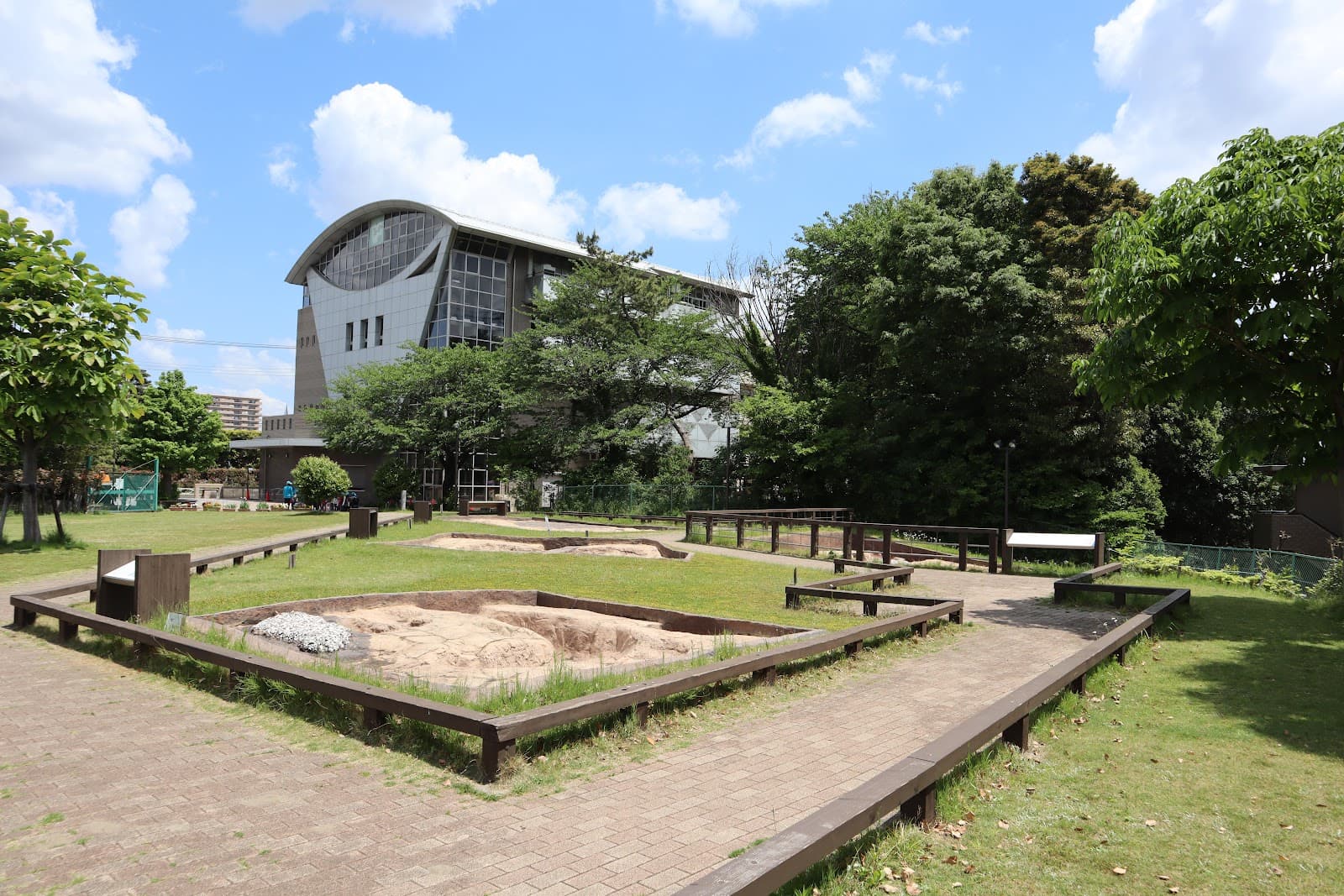
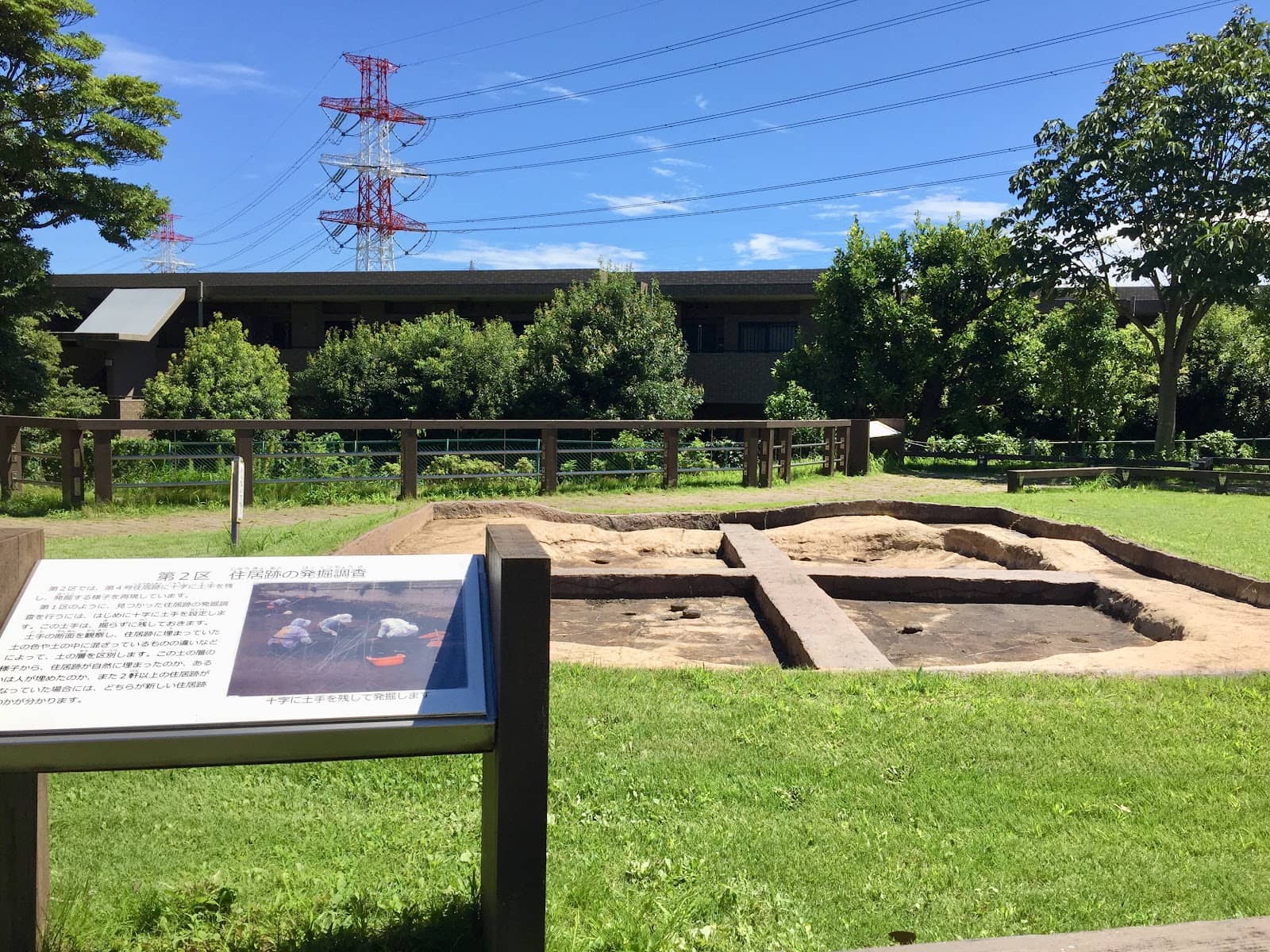
The Tobinodai Shell Mound is an archaeological site from the early Jomon period (approximately 7,000 years ago) that spans Kaijin Junior High School and its surrounding area (Kaijin 3-4-chome, Funabashi City). The site is located on the edge of a plateau at an elevation of 12-15 meters, stretching 600 meters east to west and 60-200 meters north to south along a small valley to the south. It covers an area of approximately 76,000 square meters. The first excavation survey was conducted by Sugihara Sosuke in 1932. A 1938 survey by the Tokyo Archaeological Society uncovered Japan's first "fire hole," which became widely known among researchers. "Roana" hearths are characteristic relics from the early Jomon period and are thought to have been outdoor facilities used for cooking and smoking. The first extensive survey, conducted in 1977-1978 for the reconstruction of Kaijin Junior High School, unearthed over 200 hearths, the remains of six pit dwellings, and over 30 shell middens, along with numerous pottery and stone tools, demonstrating that this was the site of a representative early Jomon settlement in the Tokyo Bay area. The third survey (in the historic park area), conducted in 1992-1993, uncovered the remains of a male and female human burial (joint burial) beneath the shell midden. The discovery attracted significant national attention due to the scarcity of early Jomon human bones and the fact that it was an example of an ancient communal burial. The early Jomon period was a time when the natural environment, including topography and vegetation, underwent major changes, such as the end of a long ice age and the introduction of a warmer climate, as glaciers melted and sea levels rose. At the same time, people's lifestyles also underwent a major shift, from nomadic to settled. In the Tokyo Bay area, the full-scale use of seafood began during this period. The Tobinodai Shell Mound is an archaeological site that is essential for understanding the lives of people at that time. For this reason, Funabashi City has decided to preserve and utilize this site as a city-designated historic site. Here, the excavation procedures and the conditions at the time of excavation are reconstructed. Funabashi City Board of Education""
Mitsuhiro
"From the outside it looks like a nice park, but this is a very precious place. This is an early Jomon period site where the first "fire hole" was confirmed in Japan, and it is a site that has been preserved from the perspective of those involved in the excavation.
At a normal historical site, a stone monument or explanatory sign is put up and that's the end of it.
However, this site has been preserved and exhibited in a way that allows visitors to see the progress of the excavation. The enthusiasm of those involved in preserving and opening this shell mound to the public was probably taken into account. Perhaps they were directly involved in the design. This is a place that conveys the desire for visitors to "understand." Funabashi City has done a great job.
PS: After seeing this place, please do visit the adjacent museum. You'll easily become a Jomon maniac (wry smile)."
山地雅宏
What People Like
What People Dislike
Frequently Asked Questions
🚇 🗺️ Getting There
Tobinodai Shell Midden Park is conveniently located less than a 10-minute walk from Shin-Funabashi Station. This makes it easily accessible via public transportation for visitors coming from different areas.
Information regarding specific parking facilities at Tobinodai Shell Midden Park is not widely detailed, but its proximity to Shin-Funabashi Station suggests public transport is the primary recommended method of arrival.
From Tokyo, you can typically take a train to Shin-Funabashi Station. The park is then a short walk away, making it a feasible day trip destination.
🎫 🎫 Tickets & Entry
The park is described as a city-designated historic site and a valuable archaeological area. Entry is generally free, allowing visitors to explore the grounds and learn about the Jomon period.
Specific opening hours for the park itself are not always explicitly stated, but it is generally accessible as an outdoor historical site. It's advisable to check with Funabashi City or the adjacent museum for any specific access times.
While the park itself is free to enter, the adjacent Tobinodai Historical Park Museum may have an admission fee. It's recommended to check the museum's official website or contact them directly for current pricing.
🎫 🧭 Onsite Experience
You can see the preserved archaeological remains of an early Jomon period settlement, including pit dwelling foundations, shell middens, and the significant 'roana' hearths. The site offers a tangible connection to ancient life.
The park is an educational site focused on archaeology. While children can learn about history, there are no traditional playground facilities. It's best for families interested in historical exploration.
The park is described as having limited facilities, with only a couple of resting tables. Restrooms and more comprehensive amenities are likely available at the adjacent museum.
Photography for personal use is generally permitted at historical sites like Tobinodai Shell Midden Park. However, always be respectful of the archaeological remains and other visitors.
A visit to the park itself might take 30-60 minutes to walk around and observe the remains. However, to fully appreciate the site, allocate an additional hour or more for the adjacent museum.
🍽️ 🍽️ Food & Dining
As the park is located near Shin-Funabashi Station, you'll find various dining options in the vicinity of the station. These range from local eateries to more established restaurants.
Yes, visitors can have picnics on the grassy areas. Bringing a mat is recommended as seating is limited. Enjoying a meal amidst this historical setting can be a unique experience.
📸 📸 Photography
The best photography opportunities are the exposed archaeological features themselves, like the hearths and dwelling outlines. The open grassy areas also offer scenic views of the historical landscape.
Drone usage is typically restricted at historical and archaeological sites to protect the integrity of the remains and ensure visitor safety. It's best to assume it's not permitted unless explicitly stated otherwise.


Social
from TikTok, Instagram & Reddit