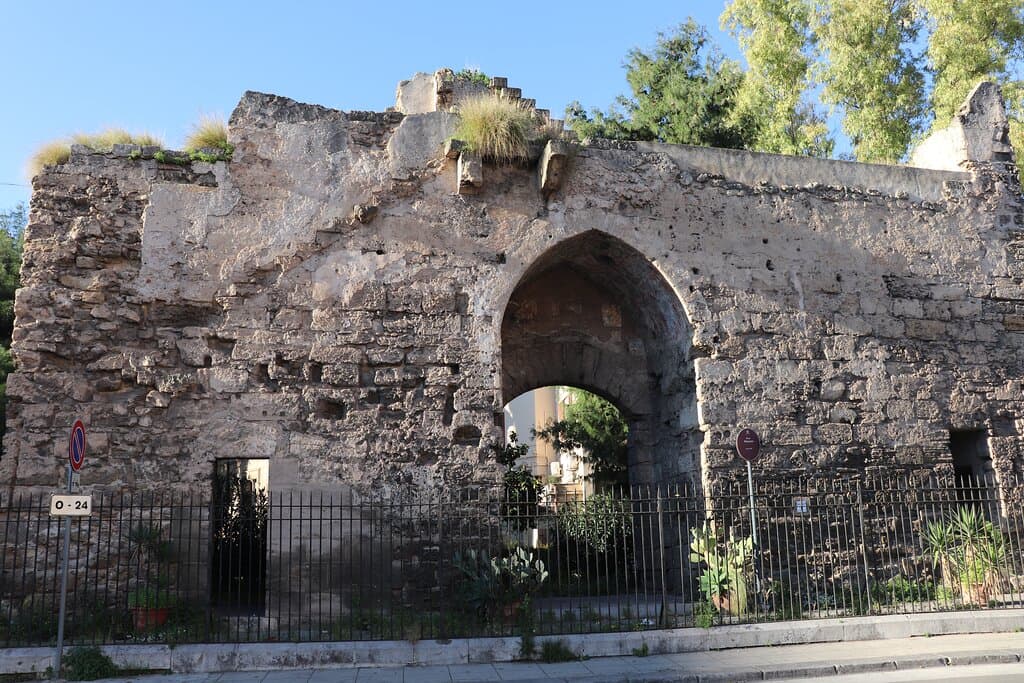
Porta Palermo city gate
A surviving Arab-era city gate, Porta Mazzara offers a tangible connection to Palermo's medieval past, hidden within a university institute.

Highlights
Must-see attractions

Social
From TikTok & Reddit
Best Time
Fewer crowds at the university
Porta Palermo city gate
Best Time
Fewer crowds at the university
Highlights
Must-see attractions
A surviving Arab-era city gate, Porta Mazzara offers a tangible connection to Palermo's medieval past, hidden within a university institute.
"A vivid testimony to the Balarm that so inspired Arab poets and countless travelers in the Middle Ages."

Check University Access
Confirm visiting hours & entry rules for the Pathology Institute before you go. :ticket:
Look for Faded Frescoes
Examine the gate closely for remnants of ancient artwork. :art:

Highlights
Discover the most iconic attractions and experiences
Porta Mazzara's Ancient Archway
University of Palermo, Institute of General Pathology
Step back in time through this surviving Arab-era city gate, a testament to Palermo's medieval past.

Traces of History
Porta Mazzara
Discover faded frescoes and architectural elements that whisper tales of Palermo's diverse historical eras.

Remnant of Arab Walls
Porta Mazzara
Experience a tangible piece of the ancient city walls that once defined medieval Palermo.
Plans like a pro.
Thinks like you
Planning Your Visit
Uncover Palermo's Ancient Gateway
Accessing Porta Mazzara
Best Times
Insider Tips
from TikTok, Instagram & Reddit
Check University Access
Confirm visiting hours & entry rules for the Pathology Institute before you go. :ticket:
Look for Faded Frescoes
Examine the gate closely for remnants of ancient artwork. :art:
Understand Its Past
Research its Arab origins and 16th-century modifications for a richer visit. :books:
Tips
from all over the internet
Check University Access
Confirm visiting hours & entry rules for the Pathology Institute before you go. :ticket:
Look for Faded Frescoes
Examine the gate closely for remnants of ancient artwork. :art:
Understand Its Past
Research its Arab origins and 16th-century modifications for a richer visit. :books:
What Travellers Say
Reviews Summary
Porta Mazzara is a significant historical remnant of Palermo's Arab walls, offering a glimpse into the city's medieval past. While its location within a university institute can make access challenging, visitors appreciate its historical depth and the faint traces of ancient frescoes. It's a site for those who seek out less-trodden historical paths.
"Porta Mazzara, dating back to the last phase of Arab domination, is one of the oldest gates in the city walls that surrounded Palermo.
It was restored in 1326 by Frederick of Aragon and at the end of the sixteenth century, given the advance of the war industry, for defensive purposes its transit was closed and it was incorporated into a bastion (the bastion of Pescara) where a new gate (Porta Montalto) was built, more fortified.
In 1885, demolition work began on Porta Montalto and the bastion and the ancient gate was finally brought to light.
Since 1953, for protection reasons, it has been placed within the fence of the Institute of General Pathology of the University of Palermo."
Itvara X
"Palermo's Arab walls were modified in the 16th century for artillery purposes. This ancient Arab city gate thus became an integral part of the Montalto Bastion. Its history was complex until its final restoration. Together with the nearby walls leading to the ancient Shantagat Gate, later known as Sant'Agata Gate, Porta Mazara is a vivid testimony to the Balarm that so inspired Arab poets and countless travelers in the Middle Ages between 800 and 1200."
Jean Paul Barreaud
"It is one of the few surviving elements of the ancient city walls, and above all of the gates that opened in the city walls in the medieval era. Brought to light at the end of the 19th century, when the nearby Porta Montalto was demolished, it still presents traces of frescoes and elements that recall various eras of the city's history."
salvo azzarello
What People Like
What People Dislike
Frequently Asked Questions
🚇 🗺️ Getting There
Porta Palermo city gate, also known as Porta Mazzara, is located within the Institute of General Pathology of the University of Palermo. You'll likely need to travel to the university campus. Public transport options within Palermo can get you close to the university area, but specific directions to the institute itself will be necessary. It's recommended to use a navigation app once you're in the vicinity.
Finding Porta Mazzara can be a bit tricky as it's situated within a university institute. It's not a standalone monument with clear signage. You'll need to navigate to the Institute of General Pathology.
The University of Palermo is accessible by various public transport methods. Buses are a common way to get around the city. Check local bus routes and schedules for the most convenient option to reach the university campus.
🎫 🎫 Tickets & Entry
Since Porta Mazzara is located within the Institute of General Pathology, you may need to inquire about entry requirements. It's not a typical tourist attraction with a dedicated ticket booth. Access might be limited or require special permission.
The opening hours for Porta Mazzara are tied to the operating hours of the Institute of General Pathology at the University of Palermo. It's crucial to contact the institute directly or check their official website for any visitor access information.
Visiting Porta Mazzara is likely dependent on the university's schedule and any access policies for the pathology institute. It's best to plan your visit during standard university operating hours and confirm if public access is permitted.
As it's part of a university institute, there might not be a direct admission fee for Porta Mazzara itself. However, any access granted could be subject to the institute's policies. It's advisable to confirm this when inquiring about visiting.
🎫 🧭 Onsite Experience
At Porta Mazzara, you can see an ancient Arab city gate, a significant remnant of Palermo's medieval walls. Look for traces of frescoes and architectural elements that reflect its long and varied history.
Porta Mazzara has undergone restoration, but as it's an ancient structure, some elements may show signs of age. The reviews suggest it's a vivid testimony to the past, with traces of frescoes still visible.
Porta Mazzara is one of the few surviving elements of Palermo's ancient Arab city walls, dating back to the Arab domination. It played a role in the city's defenses and was incorporated into later fortifications before being rediscovered.
Photography policies would likely depend on the rules of the Institute of General Pathology. It's best to be discreet and respectful of the university environment.
The reviews mention viewing it from the outside. Given its location within a university institute, a comprehensive external view might be the most feasible way to appreciate its architecture.
For Different Travelers
Tailored advice for your travel style
History Enthusiasts
Pay close attention to the surviving architectural details and any visible traces of frescoes. These elements are silent storytellers, offering glimpses into the artistic and cultural influences that have shaped Palermo over centuries. Visiting this site provides a unique perspective on the evolution of urban defense and city planning in the Mediterranean.
University Visitors & Students
Be mindful of the academic environment. While the gate is a historical artifact, it resides within an active institute. Respect any posted rules or guidelines, and consider inquiring about viewing possibilities if you have the time and interest. It's a chance to connect with the city's heritage right on campus.
Deep Dives
In-depth insights and expert knowledge
The Layered History of Porta Mazzara
Over centuries, the gate witnessed significant transformations. During the 16th century, as military technology evolved, Palermo's walls were adapted for artillery. Porta Mazzara was integrated into the Montalto Bastion, and a more fortified gate, Porta Montalto, was constructed. This period saw the ancient gate largely obscured, its historical importance temporarily overshadowed by newer defenses.
The rediscovery of Porta Mazzara occurred in the late 19th century with the demolition of Porta Montalto. Brought back to light, it revealed traces of its layered past, including faded frescoes and architectural details from various eras. Since 1953, it has been housed within the fence of the Institute of General Pathology at the University of Palermo, a unique setting that preserves this historical gem.
Navigating Access to a Hidden Gem
It's essential to approach your visit with an understanding that you are entering an active academic and research environment. While the gate is a historical monument, its current setting dictates the terms of access. Travelers have noted that checking with the institute beforehand is crucial to avoid disappointment. This might involve contacting them via phone or email to inquire about any possibilities for viewing the gate, especially if you are not affiliated with the university.
For those who manage to gain access, the experience offers a more intimate connection with history. Being within the university grounds allows for a quiet contemplation of the gate's ancient stones and faded artwork, away from the usual tourist crowds. It's a reminder that some of Palermo's most profound historical treasures are found in unexpected places.


Social
from TikTok, Instagram & Reddit